
e-GP Guide
Local Market Entry and B2B Trust: Why on-the-Ground Partners Matter

Local Market Entry and B2B Trust: Why on-the-Ground Partners Matter
A website in English does not make you present in Accra, Tunis, or Cairo. Buyers still ask who will fix a problem on a Tuesday afternoon, who knows the port, and who will not vanish when a ministry form changes. Local market entry B2B partners exist because trust is geographic. Platforms carry information. People carry accountability.
This article stays at market level: why partners matter, how to choose them, how to govern them. It does not discuss internal commercial splits, signing payments, or any headquarters–partner fee math.
What a laptop cannot do
Language in the room. Cash-and-carry culture. Knowing which importer actually pays. Sitting in a warehouse when a lot is disputed. Explaining a delay to a retailer who has never heard of your Incoterm.
Remote sales can start a conversation. Fulfilment and collections usually need someone whose reputation lives in that city.
That is the case for local market entry B2B partners — distributors, agents with a defined scope, or a local sales-and-service desk — not for “a cousin with WhatsApp.”
What a good local partner actually does
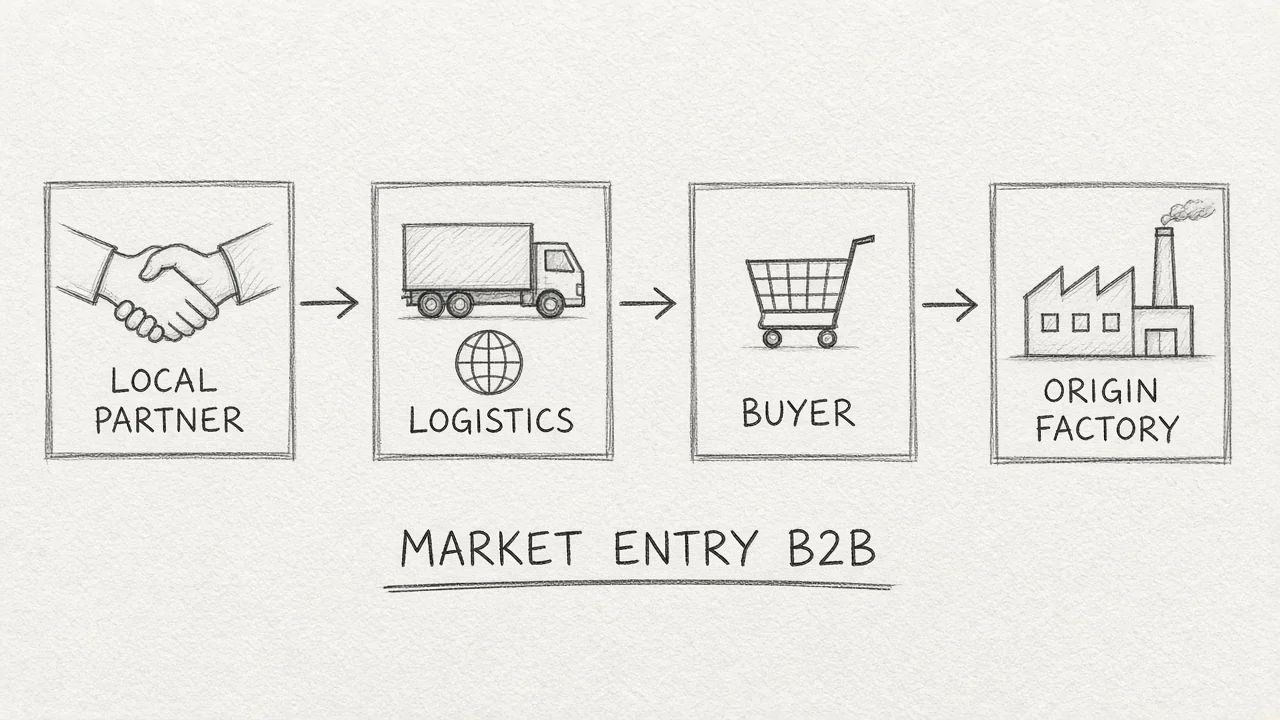
- Introduces you to *named* buyers and reports honestly when there is no fit
- Handles last-mile logistics or names a 3PL they will stand behind
- Translates specs and complaints without hiding quality issues
- Keeps a buffer stock if that is the model
- Represents you without promising what you cannot ship
What they should not do: take exclusivity for a whole region with no targets; mix your goods with unknown lots; collect your money into a personal account with no reconciliation.
How to choose without romance
Score: sector knowledge, existing accounts, warehouse, financial standing, ethics rumours you can check, and willingness to work on a trial period.
Visit. A partner who cannot show a site is a messenger.
Write: territory, products, duration, targets, branding rules, who owns customer data, how disputes escalate. Review after a season, not after a decade of silence.
If two partners compete in the same mall without rules, you will train the market to buy on price only.
Platforms plus people
A B2B platform helps discovery, catalogues, and a first verification layer. It does not replace the person who knows that this retailer only receives on Thursdays.
Use both: find and be found online; close and serve on the ground. Companies that pick only one usually stall.
A 90-day entry sketch
Days 1–30: desk research, two visits, three candidate partners.
Days 31–60: trial SKU, joint customer meetings, written trial terms.
Days 61–90: keep, split territory, or leave. Do not drift.
Language, after-sales, and when not to appoint anyone
If your product needs installation or warranty, a partner without technicians is a complaint factory. Spare parts lists and response times belong in the partner file. Local market entry B2B partners who only “open doors” and cannot close tickets will burn the brand in a season.
Language: marketing copy in the local language is not optional for many categories. Who writes it, who approves claims, who is liable for a misleading ad — write that down.
Do not appoint a partner because they hosted a good lunch. Do not skip a partner because you had one bad agent five years ago in a different sector. Score this firm, this year.
If the market is tiny, a non-exclusive importer plus your own visits may beat a grand exclusive. Exclusivity is a tool. It is not a compliment you owe.
Headquarters still owes the partner honest lead times. Partners still owe headquarters honest stock and complaint data. Trust is two-way. Platforms make the catalogue visible; they do not referee a silent warehouse.
Exclusive, non-exclusive, and the quiet second channel
If you grant exclusivity, put volume, a review date, and what happens if they miss. Local market entry B2B partners with empty exclusivity will block better partners. If you refuse all exclusivity, some serious distributors will refuse you. That is a negotiation, not a moral law.
A quiet second channel (your own key-account visits) can keep you honest about sell-through. Tell the partner if the contract allows it. Surprise parallel imports destroy trust.
Do not appoint a partner to “do government relations” as their only job unless you understand lobbying rules in that country. That is a different risk file.
Share forecast quality both ways. Partners who hide stockouts and principals who hide factory delays are the same failure mode.
When you leave a partner, agree customer notice and remaining stock. Ugly breakups become market rumours that last years.
Use a platform so new buyers can still find the principal. Then let the local partner own the Tuesday afternoon problem. That split — discoverability plus presence — is the whole point of this article.
Put a review date in every appointment letter; partners who cannot face a review were never partners, they were a hope.
Forecasts, leftover stock, and a clean exit
Share honest forecasts both ways. Hidden factory delays and hidden stockouts are the same failure. Local market entry B2B partners should also agree what happens to leftover stock and customer notice if you part.
If after-sales matters, do not appoint a door-opener without technicians. Tickets are the brand.
Exclusivity needs volumes and a review date. Empty exclusivity blocks better partners. Surprise parallel sales destroy trust — disclose second channels if the contract allows.
Skip “government relations” as a sole job description unless you understand local rules. That is a different file.
Discoverability online plus a person on Tuesday afternoon is the model. GoBiDx helps the first. The partner is the second. Write both into the plan.
Closing
Market entry is a trust problem. Local market entry B2B partners who live with the buyer solve problems a headquarters email cannot. Choose them like a supplier: evidence, trial, contract.
Use GoBiDx to make the company discoverable and the catalogue clear, then let on-the-ground partners do what only they can do — show up.
Sources / further reading (optional)
- Practical distributor-agreement checklists (legal counsel for the actual contract)
- Trade-fair follow-up discipline (named next steps)
Comments
Loading comments…
Checking sign-in…