
e-GP Guide
How SMEs Can Realistically Enter Government and Corporate Tenders

How SMEs Can Realistically Enter Government and Corporate Tenders
Tenders look like a way to skip slow sales. They are a different sport: eligibility, deadlines, bid bonds, and evaluators who score what is on the form — not what you meant. SME government tenders and large corporate RFPs can still be won by smaller firms, usually on lots that match your actual capacity, not on a fantasy nationwide contract.
This is a realism guide. If you cannot deliver 10% of the scope, do not bid 100%.
Eligibility is the first product
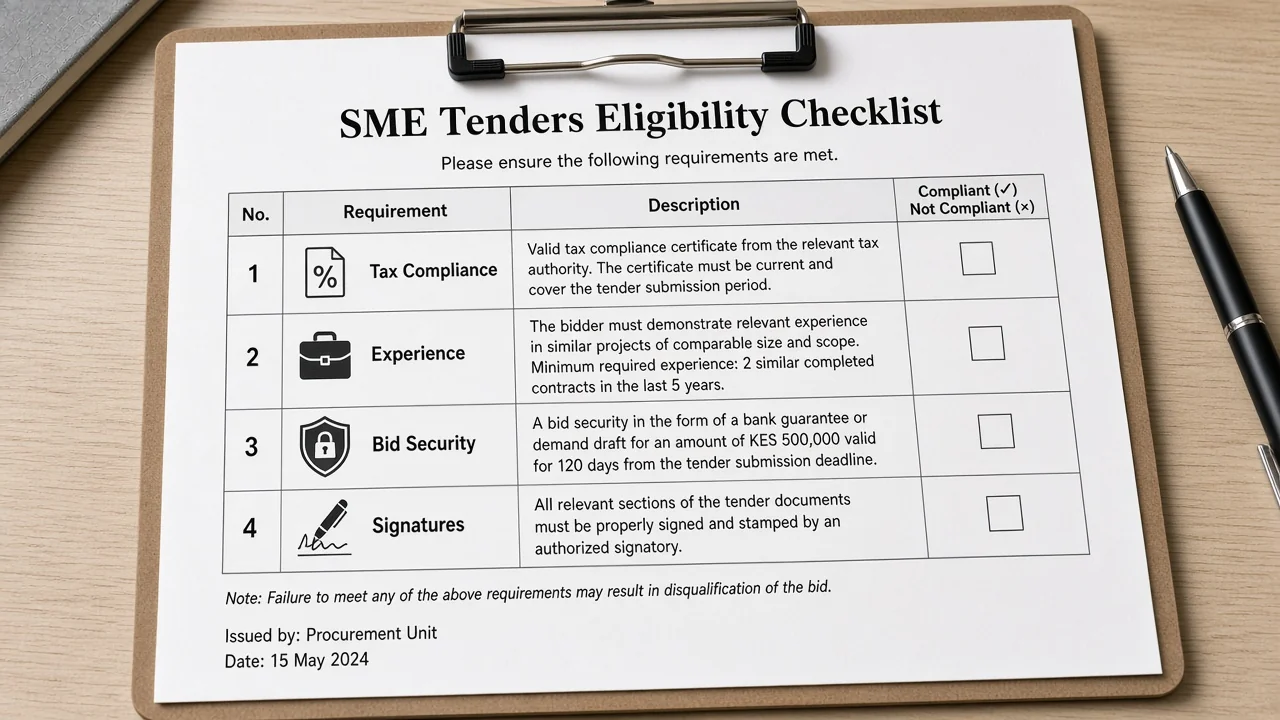
Before you price, print the qualification criteria. Typical gates: years in business, turnover, similar experience, tax clearance, licences, key staff CVs (as *bid documents*, not a careers blog), equipment lists, and bid security.
If you fail a mandatory yes/no, your price is irrelevant. Do not pay a consultant to “fix” a missing licence overnight with a photocopy trick. That is how you get blacklisted.
Corporate tenders add vendor registration portals, insurance, and sometimes quality certifications. Register in quiet months, not the week the RFP drops.
Pick lots, not glory
Public buyers often split lots. Bid the lot you can staff. Joint ventures and subcontracting are legitimate when the tender allows them — write the agreement before you submit, not after award.
If a tender is clearly written for an incumbent with a warehouse you do not have, pass. Bid-writing time is a cost.
SME government tenders with SME set-asides exist in some systems. Read the definition of SME they use. Your self-image is not the legal test.
Documents that actually score
Follow the template. If they want Form A in PDF and Form B in Excel, do that. Evaluators have a grid. Creative brochures that ignore the grid waste ink.
Evidence: contracts, completion certificates, photos of sites (if allowed), references with phone numbers that work. Do not invent a hospital you never supplied.
Price arithmetically. A spreadsheet error is a gift to competitors.
Money and time
Bid security ties up cash. Performance bonds come later. Model the working capital. A “win” that starves the rest of the business is not a win.
Calendar: question period, site visit, submission channel (portal vs box). Digital portals eat late bids without mercy.
Ethics and red flags
Anyone selling the “evaluation sheet in advance” is selling fraud. Walk. So is a request to bid as a front for a politically connected firm without you controlling delivery.
If a corporate buyer wants a sample at your full cost with no process, cap it. Tenders should not be unlimited free consulting.
A 30-day tender-readiness sprint
- Gather tax, registration, and licence PDFs in one folder
- Write two past-performance one-pagers
- Register on the two portals that matter in your market
- Read one full tender end-to-end without bidding (practice)
- Decide a no-bid list (scope too big, payment too slow, ethics smell)
Corporate portals versus gazettes
Corporate procurement is often a vendor portal: insurance, diversity forms, e-invoicing. Public tenders are often a gazette plus a fee plus a bid bond. Do not use one template for both. SME government tenders fail when you paste a marketing brochure into a mandatory form. Corporate RFPs fail when you ignore their supplier code of conduct.
Debrief: if the rules allow it, ask why you lost. One sentence of truth (“no similar job of that size”) is worth more than rumours of corruption — which may also be true, and still do not help you bid the next lot.
Framework agreements: winning a place on a panel is not a PO. You still have to win call-offs. Model that.
If your working capital cannot float 90-day public payment, do not bid. A win that bankrupts you is not a growth story. Factoring and mobilisation advances exist in some systems; they have their own paperwork. Price the delay.
Site visits: go. Notes from a visit win evaluations that a copy-paste bid loses. Photograph what you are allowed to photograph. Write the access constraints into your method statement.
Joint bids without losing the company
If you JV, write who does the work, who holds the money, and who is liable for liquidated damages — before submission. SME government tenders are full of JVs that explode after award. A one-page term sheet is not optional.
Subcontracting: some tenders cap it. If you hide a sub, you can be thrown out. Name them if required.
Do not bid as a “front” for a firm that cannot pass eligibility. You will own the performance failure.
Price: include the cost of bid bonds, translations, and a site engineer if the method statement implies one. Optimistic pricing is how SMEs win and then fail inspections.
After two or three losses on the same buyer, change lot size or stop. Repeating a failed template is not persistence. It is a habit.
Keep a calendar of portal passwords. Locked accounts on submission day are a self-goal.
When you are not in a bid cycle, still keep registrations alive and a profile findable on GoBiDx so corporate buyers can invite you instead of you only chasing gazettes.
Print the mandatory yes/no grid and tick it before anyone opens the pricing sheet; a beautiful price on a failed form is theatre.
If payment terms are 90 days and you cannot float them, the tender is not an opportunity; it is a working-capital trap with a stamp.
Save portal passwords in a shared manager before submission week; a locked account on the hour is a self-inflicted disqualification.
Go to the site visit even if you think you know the building; evaluators score what you wrote about access, not what you assumed.
Closing
Tenders reward boring competence: eligibility, evidence, arithmetic, and delivery. SME government tenders and corporate RFPs are enterable when you match lot size to capacity.
When you are ready to be found between bid cycles, keep a complete B2B profile and watch tender-style opportunities on GoBiDx — then only bid what you can perform.
Sources / further reading (optional)
- National public procurement authority manuals
- Buyer vendor-registration help pages
Comments
Loading comments…
Checking sign-in…